
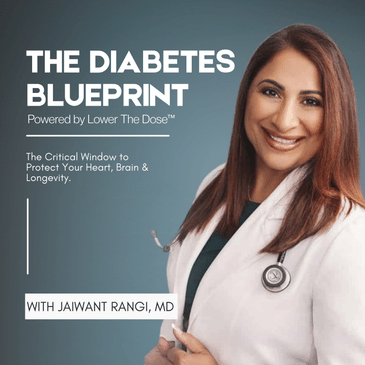
Welcome to Lower the Dose. Today, we're taking a deep dive into one of the most confusing and debated health topics: diabetes reversal. Host and endocrinologist Dr. Rangi, explores what diabetes reversal really means, the silent decade before diagnosis, and the critical windows where change is possible. With social media flooded by quick-fix gurus and misinformation, we ask: What’s fact, what’s hype, and what are your realistic options for navigating type 2 diabetes? Whether you’re newly diagnosed, living with diabetes for years, or simply curious, this episode will arm you with science-backed clarity, hope, and practical strategies to take charge of your health journey.
00:00 How insulin and the pancreas work
05:27 Understanding metabolic health trends
09:21 Understanding diabetes management stages
10:47 Understanding types of type 2 diabetes
16:16 Early diabetes management importance
20:07 Understanding CKM syndrome and diabetes
21:28 Managing diabetes through lifestyle changes
24:49 Diabetes remission and lifestyle factors
30:07 Improving quality of life with tech
31:28 Weight loss benefits in window three
36:24 Dangers of stopping medications abruptly
39:44 Understanding GLP1 medications
41:33 Discussing long-term treatment options
44:37 Managing overall cardiometabolic health
49:36 Realistic diabetes treatment advice
51:10 Ending the conversation
Lower the Dose: Understanding Diabetes Reversal, Remission, and Protection
In this episode of Lower the Dose, Dr. Rangi, an endocrinologist deeply passionate about cutting through the noise and misinformation surrounding type 2 diabetes. With the explosion of “diabetes reversal” trends online, it’s never been more important to understand what’s based in science versus media hype. Here are the key takeaways and insights from their conversation.
1. Diabetes Isn’t a One-Size-Fits-All Disease
According to Dr. Rangi, type 2 diabetes is more complex than most realize. There are at least five different types, each depending on unique features like weight, insulin resistance, and even autoimmune elements (01:01). Rather than seeing diabetes as a single diagnosis, it’s crucial to understand each person’s unique profile in order to tailor prevention and treatment strategies.
2. Silent Decade: The Hidden Window Before Diagnosis
Most people believe diabetes appears suddenly, but in reality, there’s what Dr. Rangi calls “the silent decade” the 10 years before a formal diagnosis where blood sugars are slowly creeping up (03:31). During this period, a person may feel completely fine and show no symptoms, yet crucial changes are happening under the surface. The good news? About 36% of people with prediabetes return to normal on their own with the right interventions (04:18). Early blood tests and proactive engagement with a healthcare team can make all the difference.
3. Three Windows: Where Are You?
Dr. Rangi introduces a powerful framework for thinking about diabetes progression, broken down into three “windows”:
Reversal Window: 10 years before diabetes or within 5 years of diagnosis. In this window, aggressive lifestyle changes and 5-10% weight loss can lead to dramatic improvements, with remission rates up to 86% for those who lose significant weight (08:21, 12:12). This is the best opportunity for true reversal.
Remission & Protection Window: 5-10 years after diagnosis. Here, reversal becomes less likely but not impossible. Remission (where diabetes is “put to sleep” with good control) is achievable for some, especially with intensive interventions. However, “legacy effect” means that the earlier you optimize your blood sugar, the better your long-term protection against complications like heart disease and kidney failure (16:16, 18:12).
Protection Window: More than 10 years since diagnosis. While reversal is unlikely, it’s by no means hopeless. The focus shifts to optimizing blood sugar, blood pressure, cholesterol, and quality of life. Modern medications like GLP1 agonists and SGLT2 inhibitors offer powerful tools for protecting heart and kidney health, and continuous glucose monitoring can provide even more control (24:49, 29:11).
4. Weight Loss: A Key Theme, But Not a Miracle Cure
A recurring theme is the importance of even modest weight loss – just 5–7% of your body weight can yield significant metabolic benefits (12:07). However, Dr. Rangi warns against “miracle cures” that flood social media. Diets like keto, intermittent fasting, and low-carb can all help if they are sustainable, but there is no single diet or supplement that works for everyone (37:47). The best approach is the one you can stick to for life.
5. Hope at Every Stage
Not everyone will achieve remission or reversal, but good blood sugar control always pays dividends. Dr. Rangi emphasizes that no matter what window you’re in, there’s always something proactive you can do: optimize medication, focus on nutrition and movement, protect organs, and preserve quality of life (48:44).
6. Don’t Fall for Hype – Seek Individualized, Evidence-Based Care
The diabetes “business” is full of false promises, quick fixes, and dietary extremes, which can be misleading and discouraging. Instead, Dr. Rangi urges listeners to work closely with credible medical professionals who consider the full picture timing, duration, individual risks, and evidence-based interventions (49:36).
Bottom line? Know your window, act accordingly, and don’t lose hope. The earlier you act, the more tools are available, but there are evidence-based solutions for every stage of diabetes.
For more detail, check out Dr. Rangi’s book, The Silent Decade, and listen to the full episode for an in-depth, myth-busting discussion about navigating your personal diabetes journey.
Show Website - https://lowerthedosepodcast.com/
Dr. Rangi's Website - https://rangimd.com/
Podcast Partner - TopHealth - https://tophealth.care/
Dr. Rangi's LinkedIn - https://www.linkedin.com/in/jaiwant-rangi-md-face-32226b97/
“Disclaimer: Informational only. Not medical advice. Consult your doctor for guidance.”
There's so many gurus out there who are helping divorce diabetes or wannabe experts, and I want to make sure people understand what it's true. Diabetes doesn't happen overnight. It's a silent decade. I'm tired of seeing divorce your diabetes in 30 days. Books out there that will say, I have the solution for you. They don't want to even use the word remission. It depends how long you've had diabetes. Can you do anything about it? Yes, there are three windows. There's first is the reversal window, which is 10 years before diabetes. Five to six years is what the scientists have shown that is a time to make a reverse. Now, once you're beyond five to six years of diabetes diagnosis, that's when remission is possible, but not reversal. So you cannot take it back to normal cells, but you can put them to sleep. So it does not come back again. Beyond that, it's not a hopeless situation. You're not going to be able to put in remission, but that's when the protection becomes important. So you gotta know which window you are in, you gotta know what should be your best plan.
SPEAKER_00Diabetes reversal. Something I'm interested in too because I'm one of the ones that fall into being confused about that. So, Dr. Rangi, thanks for being here. I'm excited to learn about diabetes reversal. So let's kind of hop into it. I know it's something you're passionate about. So is there anything that you wanted to say about that part?
SPEAKER_01Layla, thank you for having me. And this topic I'm really passionate about because there's so many gurus out there who are helping reverse diabetes or wanna be experts, and I want to make sure people understand what is truth, what is media hype, and what are their options. So let's go.
SPEAKER_00Absolutely. So let's kind of just dive in and start with the basics. So, what exactly is type 2 diabetes? Can you explain it in simple like layman's terms for us?
SPEAKER_01Yeah, that's a very uh important question, Leila, because uh type 2 diabetes is not just one kind, it can be many different kinds. And and there's a proposal now that there's five different kinds of type 2 diabetes that we can get into later. But let me try to simplify it for you. When you eat food, your body breaks it down into sugar. That glucose needs to get inside your cells to give you energy. Now, insulin is the key hormone that is needed that unlocks the door to get the sugar inside the cells. So that is in a nutshell the role of glucose and the insulin. Now, in type 2 diabetes, there are two things that go wrong. One is the cells become resistant, they don't respond to the insulin properly. They don't open the door, so the glucose doesn't get in, so the glucose goes high in our blood level, so it's not going in the cells. Now, it's like a lock is rusty. So there are a lot of keys floating around, there's a lot of insulin out there, we call that insulin resistance. Now, second is that your pancreas that produce insulin, that's the organ that is important for us to process all our whatever we eat, you know, to process uh with the juices that get out of there. And that's what makes insulin. And pancreas has two functions, the endocrine and the exocrine function. The endocrine function is the hormones that it releases, insulin and glucagon. And insulin, when it comes out from the pancreas, is supposed to go in the cells to open the doors to get the glucose in. That changes over time as well. So that's why I say there are two things that are happening. One is the insulin is not able to get in the cells. Two, the supply of insulin changes over time, and that organ uh pancreas gets tired and just cannot keep up with the demand. So in any person, we are looking at what's going on with the pancreas and what's going on inside the cellular mechanisms. So in the beginning, your pancreas works over time to make extra insulin. So your body's able to keep up. But over the years, it gets exhausted. So your body's capacity to make insulin goes down. And the cells that make insulin called beta cells, they start to fail. That's when the blood sugar starts rising and you get diagnosed with diabetes.
SPEAKER_00And you know, this it sounds like a process. So how long does this process actually take?
SPEAKER_01You know, everybody's different. The process can take, can happen too quick in someone, or can happen over the years. Majority of the time, it happens over the years. And this is where people miss the point. Diabetes doesn't happen overnight. There's a silent decade, and that's the uh reason I wrote the book, The Silent Decade, before diagnosis. Now, this is where the things are slowly going wrong. Your blood sugars are creeping up, your pancreas is able to work it harder and harder, but you feel fine. You have absolutely no symptoms and no warning signs. Now, studies show that about 39% of people with pre-diabetes will progress to full diabetes over the next 10 years. But here's the good news 36% actually go back to normal on their own. So this is a silent decade, which I've been referring to, where the window of opportunity is there, and we want to make sure we reverse the process and we take care of things sooner than later when it progresses to diabetes and progressively into complications. So having this pre-diabetes or this window is the best time to work on.
SPEAKER_00Absolutely. So people could catch this early, essentially, if they were tested for the right things earlier on. Exactly.
SPEAKER_01But most people don't get tested until they already have diabetes. So important for us to always stay on top of our game, be your own advocate, be a CEO of your own health. So you're always having a proactive approach to diabetes and you're looking at getting the right tests. Sometimes people don't get their blood tests done for a year or two or three, and that is just unacceptable. You may progress at that time. So get the tests early and get the right tests. Work with the right doctor so who can help you catch things early. Don't take just everything is okay for an answer. You've got to understand where you are on the spectrum. At the rate we are, one in three people in US have diabetes, uh, pre-diabetes. And if one in three have prediabetes, you are somewhere on the spectrum. So you really want to know am I absolutely metabolically healthy or is there something going on that I can do now to reverse? There could be a slight trend up. It could be going up from previous years of having glucose of 80, 88, now going up to 95. So you're still not in the fasting glucose range where we have to be bothered by it or concerned, but the trend should help us. So, yes, we can do, we can test, and uh people can understand that. And the second thing is if you are at high risk for diabetes, and who are those people who are at high risk if you have if you're overweight, if you have uh obesity, if you have a family history of diabetes, or if you have had a history of gestational diabetes, those are the three categories that definitely should be on top of their game and ask, have that discussion with the doctors.
SPEAKER_00Absolutely. So let's talk a little bit about the reversal, because that's something I wasn't totally aware of. I'm sure a lot of people have some questions on that, and it almost seems like with social media and everything like that, people talk about how they can reverse your diabetes. But what's the truth? What's what's the actual truth? Because I know we're hearing so many different things online.
SPEAKER_01Yes, and I that's where I really want to talk to people, where they understand what is social media hype and what is truth. I will take it to the example that it's it's like catching pre-diabetes is like catching amber or catching a small fire before it burns down the house. So if you can catch it early, there's a lot you can do. In my book, Three Windows, that we talk about the silent decade is that 10 years before diabetes is diagnosed. That's when things are progressing. We can catch it, we can reverse it. That's a perfect time for reversal for majority of people. Now, like I said, there are different kinds of type 2 diabetes. Some people have just traditional insulin resistant type of type 2 diabetes where this can this is possible. Some people have autoimmune diabetes, which can slowly progress. We call that LARA or latent autoimmune diabetes of adults. And that is something where eventually your better beta cells stop making insulin and you need to be on insulin. But there's still, if you have LARA and you have a lot of insulin resistance on the top, there's a lot we can do to slow the progression at that time. So, yeah, can you do anything about it? Yes, there are three windows, like I mentioned. There's first is the reversal window, which is 10 years before diabetes or within five years of diagnosis of diabetes. Five to six years is what the scientists have shown that uh that is a time you can reverse. Now, once you are beyond five to six years of diabetes diagnosis, that's when remission is possible, but not reversal. So you cannot take it back to normal cells, but you can put them to sleep. So it does not come back again. But provided you continue with your lifestyle changes as you've been advised or that are optimal for your body needs on an ongoing basis. Otherwise, you have metabolic memory. And if you stop doing the things you're supposed to do, you're gonna go back into diabetes. That's what we call as remission. You can put it to sleep, but it's not gonna go away. And that is a time from five years of diagnosis of diabetes to the next 10 years or so, or five to ten years of diagnosis. Beyond that, it's not a hopeless situation. It's just a situation where now we need to understand we're not fighting the reversal anymore. We're not like most likely we're not gonna be able to put in remission. But there are many people where we can still do it depending on their body needs, but that's when the protection becomes important. So those are the three windows I want a lot of people to understand. Are you in reversal window? Are you at a time when we can reverse it all? Are you in the remission window where we can do things to put it down to sleep? Or we are in the protection window where reversal and remission is not a possibility. And now we're gonna do whatever it takes to give you the best life, but you will probably stay on medications. But our goals should be very different in each of those windows. In protection window, my goal is to keep you as healthy as possible, protect your body from any kind of uh complications of diabetes, and and halt the progression or slow down the progression to further damage. So you you gotta know which window you are in, you gotta know what should be your best plan, and then go from there.
SPEAKER_00Absolutely. And talking about the first window, the reversal window, it seems like the pancreas is tired but not dead, right? As you said. So in that phase, what is the most helpful? Is weight loss key in that time frame?
SPEAKER_01Yeah. So, Leila, like I mentioned, uh, there are five different kinds of pre uh of type 2 diabetes that we talk about these days, which is not really a public knowledge because uh we still talk about type 2 diabetes as one type of type 2 diabetes, as one kind. Uh, but if you further uh make it, you know, subdivide it and do further testing to understand exactly the type of type 2 diabetes you have, then we can learn if you have antibodies, uh, what is your body's uh, you know, where the beta cells stay and how much can you reverse. There are two types of out of those five that are related to the weight. And if you are out of those two where they have severe resistance and the weight is a concern, then definitely weight loss will help. And majority of the people are in those two. So we want to make sure we understand if you have traditional type 2 diabetes, foundation is lifestyle. Okay, no matter which one out of the five is there, right? So eating healthy will never go out of fashion. Eating nutritious food and exercising every day will not go out of fashion or needed. It's absolutely needed. Um, and then of course, managing your stress and sleep will absolutely necessary. So that's needed for everybody, those lifestyle four factors that we talked about. But the question is how much weight loss you need to do to have. Um, you just need five to seven percent of weight loss to get the benefit. Um, there are people who have morphed obesity, so you definitely know you could lose 25% of your weight. Uh, but to get the metabolic benefit, all you need is five to seven percent of body weight loss, and that can sometimes improve and change your window.
SPEAKER_00No, that's great to know. And I think that with diet and exercise and doing the right things, that seems like it's an amount that is feasible. But when it comes to losing weight, what methods really work best for losing that amount of weight?
SPEAKER_01Um, yeah, so uh overall, 46% achieve remission at one year uh if you look at the studies, and that science is very clear. You know, when you look at the weight loss, the numbers are even more impressive for just you have, like I said, 10 to 15% uh weight loss, you can have 86% can go into remission. So, what kind of uh what can you do for the weight loss is your question. So, all you need to do is both cardio and strength training and small portions. That can take you a long way. Whatever you eat should be very nutritious, having much smaller portions and adding daily activity with a week of at least 150 minutes, and you can divide that 150 minutes over different days. But make sure you do strength training. As we age, over time we lose muscle mass. And if you don't work on building your muscle mass, then you are going to have a problem disposing the glucose over time. But if you really talk about how you can lose the weight, eating on nutrition has bigger profit over time if you really change your eating. But of course, exercise needs to be done. But if somebody's just exercising and not changing the diet, the weight loss is not going to happen and we're not gonna achieve where we need to be. Now, one more thing I want to add here nowadays, everybody wants GLP1. We get so many people asking for Ozempic and Bigobi and Zeppound and Monjaro and you know that class of medication, GLP1 aginess. People need to understand you lose 10% of muscle mass. 10%. So I have many patients I've helped lose 50 pounds, 100 pounds, 30 pounds, whatever it is. But I always tell them if you're losing almost 10% of muscle mass, you have to see where you started with. You know, you cannot afford to lose muscle. So you really need to continue to exercise to build up that muscle so you don't lose it. Um, and especially in my elderly, if they if they are really overweight and if they lose that fast fat mass, along with that, they're losing lean mass, which is muscle and bone, um, they get weak and they have risk for falls and things like that. So weight loss is important, but work with your expert team who can help you guide how to achieve that and how to change your nutrition and your exercise.
SPEAKER_00Absolutely. And let's talk about window two a little bit. So, what happens after the five-year mark?
SPEAKER_01Five years is not an absolute uh mark, but I would say we need to understand that we are losing the reversal window at that time, right? So now we are going into remission and protection window, and that is five to ten years after the diabetes has been diagnosed. During this time, remission becomes harder, but it's still possible in some people. There was a recent study in 2026 that showed that people with diabetes for at least eight years or more had a 50% remission rate with intensive weight loss compared to people who had shorter duration. Compared to 82% in those with shorter duration, only 50% of those beyond eight years could bring it into remission. So the chances drop, but they don't disappear. We could still try. But here's what makes the window special. There's something called legacy effect.
SPEAKER_00Legacy effect. That sounds important. So can you talk a little bit about that and what that is?
SPEAKER_01Yeah, that is something that I think everybody should know who has diabetes, uh, or even before getting into diabetes. Let's say you have no control and you've done everything about your lifestyle, whatever you could, and now the diabetes you have diabetes, you know, you got diagnosed. Your first few years of diabetes have the metabolic memory that go even 30 years down. So, legacy effect is if you take care of your diabetes good in the earlier part, you'll get the dividends paid over the years to come. This is one of the most important discoveries in diabetes research. And most people have never heard of it. And I feel sorry because a lot of people are bargaining at this time and saying, well, let me just try lifestyle, and they're hovering in their A1Cs in seven and eight and not a good control. So that is not a good place to be. You want to work with the doctors or experts, whoever you work with, so that you can optimize and have a better control during the first 10 years of your diabetes because if you hone it and if you really make it better control, you're going to benefit later. There was a famous study called UKPDS, you know, that started in the 1970s and they followed people for almost 40 years. Very hard to do that in medical research. They divided people into two groups. You know, one was an intensive group and uh with a tight blood sugar control, and the other one was a standard treatment. Now, after 10 years, 10 years of being diagnosed, the intensive group had better blood sugars as expected. But here's where it gets interesting. After the study ended, both groups went back into their regular doctors and the blood sugars control became similar because they just followed the standard of care and the standard treatment. It was not intensive control. You would expect the benefits to disappear, right? Wrong. The group that had good control in the first 10 years, they continued to have fewer heart attacks, fewer deaths, and fewer complications for the next 24 years, even though their blood sugars were no longer different from the other group. That's a legacy effect.
SPEAKER_00Kind of sounds almost like what you do early on will protect you forever almost, or at least in the long run.
SPEAKER_01Very important.
SPEAKER_00Absolutely. And I and I think you've said this before, it's like your body has memory almost, right?
SPEAKER_01Yep. Metabolic memory is what we call it. Yep. What you do 20 years before matters more than five years towards the end. This is why I tell patients window two, which is the remission and protection, even if you can't achieve remission, every effort should be put in into controlling your blood sugars now as an investment for your future. You're building a protection that will pay dividends for decades to come.
SPEAKER_00And that sounds pretty motivating. So it sounds like it's not all just about reversal.
SPEAKER_01Yep, not at all. And this is a time where the social media gurus get wrong. You know, they promise everybody to reverse. And that's not possible. Let people understand which window they belong in and what can we do for them the best. Because there's so much to offer in each window. Rather than everybody's focus being on reversal and getting feeling defeated and working with someone who does not know the science behind it, it's better to understand what window you're in. And if the reversal is not a goal at this time for us, for you, for that specific patient, and it's it's it's not that you have failed. You know, that's nonsense. That's what social media says. The good blood sugar control, even if you still technically have diabetes, dramatically reduces the risk of heart disease, kidney failure, amputations, blindness. These are the things that actually kill people. They destroy the quality of life. And preventing them is huge when whether or not you achieve the reversal. And nowadays we have better medications that are cardioprotective, that protect your heart, they are kidney protective. You know, we knew all these things forever that all the systems are connected when you have diabetes, and they one effect on one organ can have, you know, simultaneous effect on the other organ as well. But American Heart Association came up with this uh description called CKM syndrome or CKM criteria, where they talk about cardiac, kidney, and metabolic disease going hand in hand. And that's why you don't treat one by itself in silo. We, you know, and we treat them all as a cardiometabolic health. Uh, because it's it's definite that if you have a metabolic problem, if you don't address it, well, your kidneys and heart are going to be affected.
SPEAKER_00Absolutely. And so, what should people in the window two actually do? What would you advise?
SPEAKER_01You know, in window two, I would say first thing they should do is try for the mission. You know, lose as much weight as you can, get healthy, you know, eat nutritious food, understand what are your needs, what should you be eating. Uh, Mediterranean-based diet works the best. But there's also individual needs, uh, their ethnic backgrounds. So you may want to see your team of uh nutritionists and the doctor who can help you guide for you what is the best option. And then you exercise. So eating nutritious, exercising regularly, sleep as a prescription, hydration as a prescription, and stress management as a prescription should be considered. Once you've done those things, then you work with the right doctors to understand with the aggressive approach like, um, what can I do to get into this? You know, I'll still try to do remission for you. But if I can, then what can I do to achieve the protection? Optimize your blood sugar control. So if your lifestyle is not really taking you to that point, maybe your beta cells are exhausted and you need some support. And maybe we need to give you some medication to help you take things better, but always, always work on the foundation and optimize your blood sugar or blood sugar control. Uh what With the doctor to get your hemoglobin A1C as close to normal as possible. We consider less than 7% as optimum. That is American Diabetes Association's guidelines, but American Association of Clinical Endocrinologist ACE says less than 6.5. I try to get most people less than 6.5 A1C if possible. But then some candidates I'm okay with less than 7% as well. So we individualize care. So yeah, try to do whatever you can with your lifestyle to bring yourself into mission. Optimize with the right medications, get your A1C under the right control, and use the medications that have cardio protection effect or kidney protection or brain protection. And then don't forget about the legacy effect. You got to make sure that you stay on top of your game.
SPEAKER_00Absolutely. And thinking about window three, let's let's talk about window three a little bit. So, what about people who have had diabetes for let's say more than 10 years? Where do they go? What would you advise for them? What would they do what's best for them to do?
SPEAKER_01You know, after 10 years, when you are in the third window, like you said, which we have the silent window when the reversal is possible, then you have remission and protection, and the last one is protection only, which is 10 plus years of diabetes. That's when the beta cells or the cells that make your insulin have undergone more permanent changes. Most of them have either died or they have become dysfunctional, you know, beyond recovery. Some of them you can bring it back. Nowadays, there are studies to understand can we have beta cells that can we can bring them back, or can we do anything to preserve them? So until then, basically what we need to understand is in the protection phase, you've got to do anything that would not hurt the beta cells any further. So we got to avoid any kind of toxins. And the toxins include your, and that applies to earlier stages as well, avoiding alcohol, avoiding fat. Fat is a toxin in your bit to beta cells or your liver or any cells, environmental toxins, things like that. So whether your pancreas is working partially or working completely or 80% gone, it's hard to say exactly how much of your beta cells are working. That's when the studies consistently show that longer diabetes duration predicts lower emission rate. And the real world data from England found that disease duration was one of the strongest predictors of whether remission was achievable or not. So again, I would keep my goals the same, keep your A1C under good control, eat well, you know, keep follow the lifestyle principles that we talked about, and keeping your A1C under good control is still important. And make sure you avoid any toxins that can hurt you further.
SPEAKER_00Absolutely. And that has to be, I would imagine, really hard for some people to hear. So how do you feel about that? Is there any advice or anything that you want to speak to on that when it's hard for people to really digest and really Yeah, I I think the hard part is basically that we missed the reversal window, right?
SPEAKER_01And that's what we're talking about. Um but that's okay. We have so much more to offer at that point. I don't want to false promise them that we can still reverse you, we could do miracles or whatever, right? So you need to understand what are your options at that time, and and they want hope. And and giving them false hope is not right. I want to give them real hope. And the real hope is I have so many options nowadays that I can really help you live as normal as possible. Um, I have newer medications that can help you protect your organs. Uh, we have technology that we can use. We can use automated insulin pump delivery that can give you more when your body needs more. We can shut it off so you don't get hypoglycemia. Uh, we can give the newer insulins that are ultra-long-acting. Uh, we can give you inhaled insulin. You know, we can use so much more. We have a lot of options out there. It's just that the doctors or the providers don't know how to use what and when. Um, and a lot of people don't offer those options because they're not comfortable. They don't know the technology out there that is available or the newer medications that are available. So I don't want them to lose hope. There's so much we can do. We can optimize their hormones, we can help them, you know, get their hormones balanced so they can have live a normal life with intimacy and other things that usually gets bothered by people with diabetes because the vascular changes and the nerve changes does hurt their function and that can affect them. So there's so much more we can offer, but my focus changes from uh now it's I'm not talking about reversal and I'm not talking about admission, but let's optimize care. Let's give you the best possible care that can be offered and and help you live as normal as possible and help you not diabetes let the steal the years away from you. That's what I would say.
SPEAKER_00Absolutely. It sounds like diabetes have progressed at this point, which is what generally tends to happen. So, how can you live your best life now that you are on the stage with diabetes? So, with that being said, what do you think people should focus on in window three?
SPEAKER_01Yeah, I a great question. I mean, I I just said that, but let me organize my thoughts a little bit more for the patients. Number one, optimization. And optimization is when you understand um I need to get my A1C under control, I need to get my blood pressure, I call it ABCs. Your A is A1C, B is your blood pressure, and C is your cholesterol. So make sure you get your ABCs under control, make sure you get the right medications that is good for your cardio protection. Make sure you have uh no hypoglycemia or low blood sugar because that can hurt you too. So I call that as optimization. The second uh focus my uh for this uh third window is protection. So you want to do anything and everything that protects your heart, your brain, your kidneys, and your overall well-being, right? And my so use the right medication. We use GLP1 agonists, we use SGLT2 inhibitors that have been shown to protect your organ, regardless of their effect on the blood sugar. You know, for example, SGLT2 inhibitors reduce heart failure and slow the kidney disease progression. GLP1 agonists, they reduce heart attacks and strokes. These benefits are separate from blood sugar control. Every person with long-standing diabetes should be on one or both of these medication classes unless there's a specific reason they can't take it, you know, and and we do get those. I had a few patients yesterday. They cannot take them because either they had hysteriopagnetitis or they had severe gut problems or they get repeated urinary tract infections or vaginal infection or bladder infection. So if they cannot take it, I'm not going to push for those medications, but we should know our options and we should share those with our patients. So we talked about optimization, protection, and my third is quality of life, which I discussed a little earlier about the testosterone therapy and about making it as manageable as possible. Let diabetes not control them. I don't want them to do finger prick 10 times a day or five times a day. Put them on continuous glucose monitor, let them see it on their phone. You know, I made it, I don't even have diabetes, but it helps me understand what did I eat and how did my blood sugar change? You can put people on continuous glucose monitor irrespective of whether they have diabetes or not, or irrespective of what class of drugs they're on. And this is where insulin uh insurance plays a role, and insurance would not cover it. But for people who can afford it, they should request their doctors that give me continuous glucose monitor, because that's the way to go. You know, mom monitor your sleep, uh, monitor that you're having quality sleep. You know, use the latest technology that we can to help have better quality of life. You know, uh don't chase impossible goals, uh, but make you know, there's so much more possible. Work with the right team, like I said, and it will help you achieve those goals.
SPEAKER_00Absolutely. And in Windsor 3, we talked about how weight loss is super important, and especially in window one and and two, but is it still important for window three?
SPEAKER_01Absolutely. You know, like it remember I mentioned something earlier that avoid the toxins, you know, and that depends at every stage. And obesity of fat is a toxin for your cells. Um, so even if it is it does not produce remission, weight loss in window three can reduce how many medications you need, how your blood sugar control is, it can lower your blood pressure, it can reduce your joint pain, it can improve your sleep, you know, uh improve your sleep apnea, uh, it can boost your energy and your mood. So, yes, weight loss is definitely a goal for window three. A patient who loses about 10 pounds or 10 kilograms, I should say, uh, might go from uh four uh diabetes medications to just two, you know. Remember, I mentioned five to seven percent of body weight is what you need to change metabolic changes in your body. So you will be less dependent on medications. They might be able to stop insulin completely. And I've had many of those patients where we've stopped insulin after 8, 10, even 20 years. Going on insulin doesn't mean you'll always stay on it for certain class of people. For some where the body's not making insulin at all, of course you'll stay on insulin for good. Um, so their quality of life can improve dramatically, and and that's a huge win, even if they still technically have diabetes.
SPEAKER_00Absolutely. And we touched on it a little earlier about there being so much misinformation out there or oversaturation of information, right? So let's talk about that a little bit. Why do you think that so many people promise this universal reversal idea? Money and attention.
SPEAKER_01I think those are my two big ones. You know, I'm tired of seeing reverse your diabetes in 30 days, you know, books out there that will say, I have the solution for you. Reverse or, you know, they don't even use the word remission. They'll just say reverse your diabetes in 30 days, 60 days, or whatever, and I have the magic for you. You know, it depends how long you've had diabetes, like we talked earlier in this uh podcast, and and your individual beta cell function. You know, just saying every to everybody, reverse your diabetes in 30 days is wrong information. That's misinformation, you know, we don't want to pass that. And that easily goes viral. Whenever you have something catchy, people are going to click on it more, they're going to listen to it more. Uh, there's also a fundamental misunderstanding of what the studies actually show. So when people hear 86% remission rate, they think it applies to everyone, you know, but that was 86% of people who lost 15 kilograms of weight, okay, and more had the diabetes for less than six years. So you really need to read the fine print in the studies. You know, what are they showing? Um, if you've had diabetes for 15 years and lose five kilograms, your chances are much, much lower compared to if you've had diabetes only for six years and you've lost 15 kilograms. So I think there's a lot of misinformation out there, and we need to understand how to analyze the data that we are reading in the studies.
SPEAKER_00Absolutely. And I I think from that standpoint, especially with maybe influencers or or um people that are on social media, when they're speaking generally, it's more an overall thing. It's not specific to the uh subset of people that are in one of these different windows. So, what are some of the red flags that people should watch out for?
SPEAKER_01I think the biggest red flag is understand who's talking. You don't want to listen to influencers who have not gone to medical school, who don't know what they're talking. Now, if it's somebody who's gone to medical school and is talking about the real research, yes, you definitely should pay attention. Uh, we need more of those. So I'm not saying you should not have more influencers out there, but those influencers should have a good background. You know, you've got to know where they're coming from. And and be suspicious if anyone is saying promise is reversal. You know, reversal promises is not possible without asking how long you've had diabetes. You know, watch out for that. Now, claims their specific diet or their specific supplement is going to help you reverse their diabetes. You know, I mean, I use supplements in my practice. I often tell people you could have uh certain supplements like bittermelon or chromium or cinnamon, things that help you improve your insulin sensitivity or maybe some insulin release as well. But that doesn't mean that is the magic for it. That's not what is going to help you reverse it completely. You know, I can use it to enhance, but not as the sole answer. You know, if somebody's claiming that their special diet will change things, you know, you need to have fundamental understanding of what are we talking about in the nutrition space and diet space. You cannot have just one diet. You've got to have something that you can follow over the years. You know, somebody who tells you, I'm going to help you stop your medications right away. You know, I see so many people, especially with Indian background that I know of, because that's my background, they will go to India and pick up some, you know, supplement that is sold on the premise of uh Ayurvedic medication, they'll stop all their other medications and start taking that supplement. That is wrong. Don't do that. Understand that Ayurveda can work, but in the right context at the right time, you cannot just stop all your medications. You know, if somebody's telling you doctors are hiding the cure from you, you know, I have the magic, but the doctors are hiding the cure. Or somebody's charging a lot, a lot of money for the secrets that are freely available that they know and that that did not prove it in the journals or something. So there are a lot of red flags. People should know who they're going to.
SPEAKER_00Right. And absolutely. And you mentioned certain diets and specific diets, and I think that that's something we all hear about. We all hear about all these different diets. For example, you know, like low carb, keto, and I have definitely tried some of these myself, so so I know a little bit about them. But with low carb keto intermittent fasting, what's your take on them? Do you think that they actually work?
SPEAKER_01You know, they can all work for weight loss. Um, and weight loss is what drives remission. So there's no magic diet that can reverse diabetes independently. Any diet that can help you achieve weight loss will help you improve diabetes. And one of the things I often see is uh patients will say, I am really restricting my carbs and it's so hard. I want you to restrict carbs, but be realistic. Don't do any anything that would that's not sustainable. You know, you need some amount of carbs for your brain function. So don't try to go with absolutely no carbs and now I'm going to go with carbs. So understand, you know, what is sustainable and what is nutrition and what is excessive. So low-carb diets do have some advantages for blood sugar control because you're eating less of what raises your blood sugar, right? It's like the toxin effect that I was talking about. Some studies show faster initial improvement in blood sugar with low-carb approach, and which is good because a lot of people will say, I want to see the difference. You know, they're tired of seeing no change, right? So if you want to do that, that will help. But for long-term remission, what matters most is sustained weight loss. And that depends on finding an approach that can that you can stick with forever and and not for brief time. And if you love bread and pasta and hate eating keto, you won't stick with keto. You know, if you find intermittent fasting easy, that might work for you. The best diet is the one you can maintain for life.
SPEAKER_00Absolutely. That no, that makes a lot of sense. And let's speak a little bit about medications, especially you touched on GLP1s. I think we're hearing about them everywhere. So what about medications, whether it's GLP or other medications, but do you think that they actually can help with reversal?
SPEAKER_01Yeah, the new GLP1 medications are genuinely exciting. And that's what I all day I do that in my clinic. I have to tell patients in the right people, these can be magical. But in the wrong person, they get hurt. So you really need to know who's the right person to be on it. Um, drugs like semaglutide and terzepatite, you know, semaglutide comes out in the market as osempic and um vigovi, and terzepatite is uh Zebbound and Monjaro, they produce weight loss of close to 15 to 20 percent on average, which in which is in the range that produces remission. Remember, I told you about metabolic benefits start at even 5 to 7% of body weight loss, but to bring it in complete remission, 15 to 20% will do it. Early data suggests that remission rate of 40 to 50 percent with these medications in people with shorter diabetes duration. So I really feel if somebody needs medication and somebody has a lot of weight to lose, being on these medications can help you to put you in remission if you use it at the right time. Now it has cardio protection as well, so there's rationale and reason to use it later in the diabetes as well. But you need to understand what can you achieve and what what can how can it benefit you at different stages. So here's the catch. If you stop the medication, the weight gain usually comes back. Two-thirds of the people gain the weight back if they stop the medication. So does the diabetes, you know, if you stop the if the weight comes back, so will the diabetes. And that's where the metabolic memory comes in. So it's not a cure, it's a tool that helps you achieve and maintain the weight loss needed for remission. I hope that makes sense. You may need to stay on it for long term. You need to understand, you need to work with the right doctors who can help you understand how we can best do it together, what is the lowest dose I can keep you on, what is the right time for me to taper you off if in some people I can taper them off or take them off. In some people, beriatric surgery or uh stomach bypass or stapling or certain kinds of surgeries, bariatric surgery, remains the most effective intervention with remission rate of up to 60 to 80% in some studies. Now, you have to understand that comes with side effects and complication risk and whatnot. I'm not recommending that. All I'm saying is you need to understand what are your choices and options and how can you best achieve that and what is your distric outlook.
SPEAKER_00Absolutely. And I think I've heard some information about that too. And I think a misconception is people think they can take DLPs or medication for a certain amount of time and then be done with it. But from what I'm learning and from what you're saying too, some people do need to be either tapered off in a certain way or maybe on it forever. And that also makes me think a little bit about remission. So let's talk about that as well. What happens after remission? And is that something that's permanent?
SPEAKER_01Well, this is crucial, and we talked about it a little earlier too, but it gets overlooked. So let's talk about that. Remission is not cure. The underlying tendency towards diabetes is still there. If you regain the weight, diabetes will come back. The direct study followed people for two years. Of those in remission at one year, about 70% of them maintained their remission at year two, but only if they maintain their weight loss. And those who regained the weight, they relapsed. So remission requires lifelong vigilance. You need to maintain your weight loss forever. You need regular monitoring to catch and recurrence early. You need to think of yourself as someone in remission from diabetes, not someone who used to have diabetes. You still have diabetes, but you're not on medications. So you don't think about diabetes anymore.
SPEAKER_00I think that's a very important distinction as well. So, what types of monitoring do people that are in remission actually need?
SPEAKER_01At the minimum, I think A1C is most important. I would still check their hemoglobin A1C every three to six months in the first year, and then at least every six to twelve months. You know, they recommend annually, but I really want to keep an eye on that. So if not every three months after first year, I'll go to every six months. And weight monitoring regularly is very important. Uh, and honestly, continued attention to the lifestyle factors that got you into remission. And a lot of people have, you know, 93% of US population is metabolically unhealthy. And that's a big number. So I don't just care about diabetes. I am looking at the whole picture of cardiometabolic health, you know, to achieve longevity and quality of life, you want to make sure all my parameters are in control. My blood pressure, my ABCs go back to that. My A1C is good, my blood pressure is good, my cholesterol is good, because together they define what your outcomes are going to be eventually. So I would say work with your doctor, work with them closely, keep an eye on your A1C, keep an eye on your weight, make sure your blood pressure is under excellent control. And if your blood pressure is still high and if there's room to lose weight, continue to work on weight loss efforts. It's not just diabetes that we are looking at. We're trying to bring blood pressure under better control, cholesterol under less control. And if you need to be on medications like statins or any other cholesterol medications, then have a discussion with your doctor. You cannot just say, I don't like statins, I don't want to be on statins. If you are high risk, they help with the outcomes. So we're not just talking about diabetes remission. I'm looking at cardiometabolic remission. Um, so you overall we can add longevity and keep all your parameters in check. So I getting a routine blood work, keeping your weight in check, keeping your salt in check, and regular activity and sleeping well are all those things that'll help you keep diabetes in remission and keep your ABCs in check and keep your cardiometabolic in check.
SPEAKER_00Absolutely. And I think that so far this episode has been super informative and I think we've covered a lot of information. So can you summarize a little bit overall again about the three windows just one more time?
SPEAKER_01Yeah, um, and um I I think this has been an interesting discussion because this is what I see in my practice every day, and I always try to introduce this to the patients, but it's too much to grasp. Let's talk about three windows. Window one is the reversal window, that is your pre diabetes or 10 years before diabetes when you Just getting at the risk of diabetes and at from time of diagnosis to the first five years of diabetes. That is your reversal window. Your best chance for reversal is at that time. Beta cells or the cells that make insulin can still recover. Beta cells can be, you can make them work better if you follow certain lifestyle rules. Aggressive weight loss is the key at this time. You aim at 10 to 15, 10% of body weight loss at least. Up to 86% can go into remission with significant weight loss here. And act fast. Every month matters. Remember, we talked about legacy effect. Now window two, remission window and the protection, remission and protection. This is five to ten years after the diagnosis of diabetes. Remission still is possible, but harder. About 50% with aggressive intervention. Legacy effect makes this period critical. What you do now will pay you, the benefits will go for 10, 20, 30, 40 years down the road. Good control now protects your future decades. And focus on both remission attempts and for optimal diabetes control. And use the heart and kidney protective medications here. Now the third window is your optimization and protection window that is 10 plus years after diagnosis of diabetes. This is where your true reversal is unlikely. Change your goals. Focus shifts from reversal or remission to optimization and protection. Use the medications that protect your heart and kidneys. Weight loss still is important because it can go a long way and it can also reduce your medication burden. Don't feel guilty. Focus on living well with diabetes. So I think that's what I would do with every window of diabetes. And to me, we can give them the best life possible. Nobody should feel defeated. At every stage, we have a lot to offer.
SPEAKER_00That's such a great message. And is there anything else that you want to add or add in that you haven't touched on yet for our listeners? Any final messages at all? And thank you again for being so clear and honest and transparent and really helping so many people absorb this information. Yeah.
SPEAKER_01So Layla, I think I would just tie up everything that we talked about. First, know your window. Ask yourself honestly how long you've had diabetes. This determines what's realistic for you. Don't chase impossible goals, but don't give up the achievable ones either. Okay, so first of all, know your window. Second, timing matters enormously. If you are in window one, this is urgent. Don't wait. Don't try to make small changes. Go big now. The pancreas can still recover. If you're in window two, remember the legacy effect we talked about. What you do now protects you for life. And if you are in window three, focus on optimization and protection and don't let anyone make you feel like a failure. There's a lot we can do at that time too. Number three, ignore anyone who promises miracles without asking you about your situation. Real medicine is personalized and precision-based, and anyone offering one size fits reversal is either ignorant or lying. You deserve honestly, even when the truth is complicated. The good news is that every stage there is evidence-based interventions that can dramatically improve on your health and quality of life. And we know more about diabetes than ever before. We just need to apply to the right people at the right time. And there's always something we can do. We just need to be honest about what that something is for each individual person.
SPEAKER_00Absolutely. Thank you so much. And I think that this will really help a lot of people understand their situation better and make more informed decisions about their health. And I think that's really all anyone can ask for when it comes to their health. So thank you.
SPEAKER_01Thank you for that. I hope this helps everybody understand their situation better and have a better dialogue and discussion with their doctors and their providers so they can ask for what is really possible for them.
SPEAKER_00Absolutely. Thank you so much. And for our listeners, Dr. Rangi's book, The Silent Decade Reversal, Remission or Protection, What's Your Diabetes Window, goes into all of this in more detail and is way more informative. So if you enjoyed listening to this, make sure that you do check out her book and make sure that you continue to follow and subscribe for the show. And thank you all for listening. And Dr. Rangi, I can't wait to speak to you again soon.
SPEAKER_01Thank you, Layla.
SPEAKER_00Take care.